
SIL Registration: What Unregistered Providers Must Do Before October 2026
By Sinclair Hurtis · 20 July 2026
There is a lot of noise in the market right now about SIL registration. Fear based marketing, countdown timers, and warnings about penalties are everywhere. Most of it is technically accurate but practically unhelpful if you are an operator who just wants to know what you actually need to do and in what order.
This article is the calm version. I work directly with NDIS providers on compliance, documentation, and audit preparation. What follows is what I tell providers when they ask me where to start.

What Changed and Who It Affects
From 1 July 2026, Supported Independent Living became its own mandatory registration category under the NDIS. A new registration group, 0138, and a new SIL Supplementary Module of the NDIS Practice Standards both commenced on that date.
The reform applies to two groups of providers. Providers already delivering SIL who are not currently registered with the NDIS Commission must apply for registration by 1 October 2026 to continue operating. New providers wanting to enter the SIL market after 1 July 2026 cannot deliver SIL until their registration is approved.
Providers already registered under group 0115 (Assistance with Daily Life Tasks in a Group or Shared Living Arrangement) are not affected by the application deadline. Their registration transitions automatically to group 0138. Their obligation is to comply with the new SIL Practice Standards from 1 July 2026 and to be audited against them at their next scheduled audit.
This article focuses on unregistered providers who are currently delivering SIL and need to understand what registration involves.
The Two Dates Most Providers Are Confusing
The confusion between 1 July and 1 October is the most common question I receive. Here is what each date actually means.
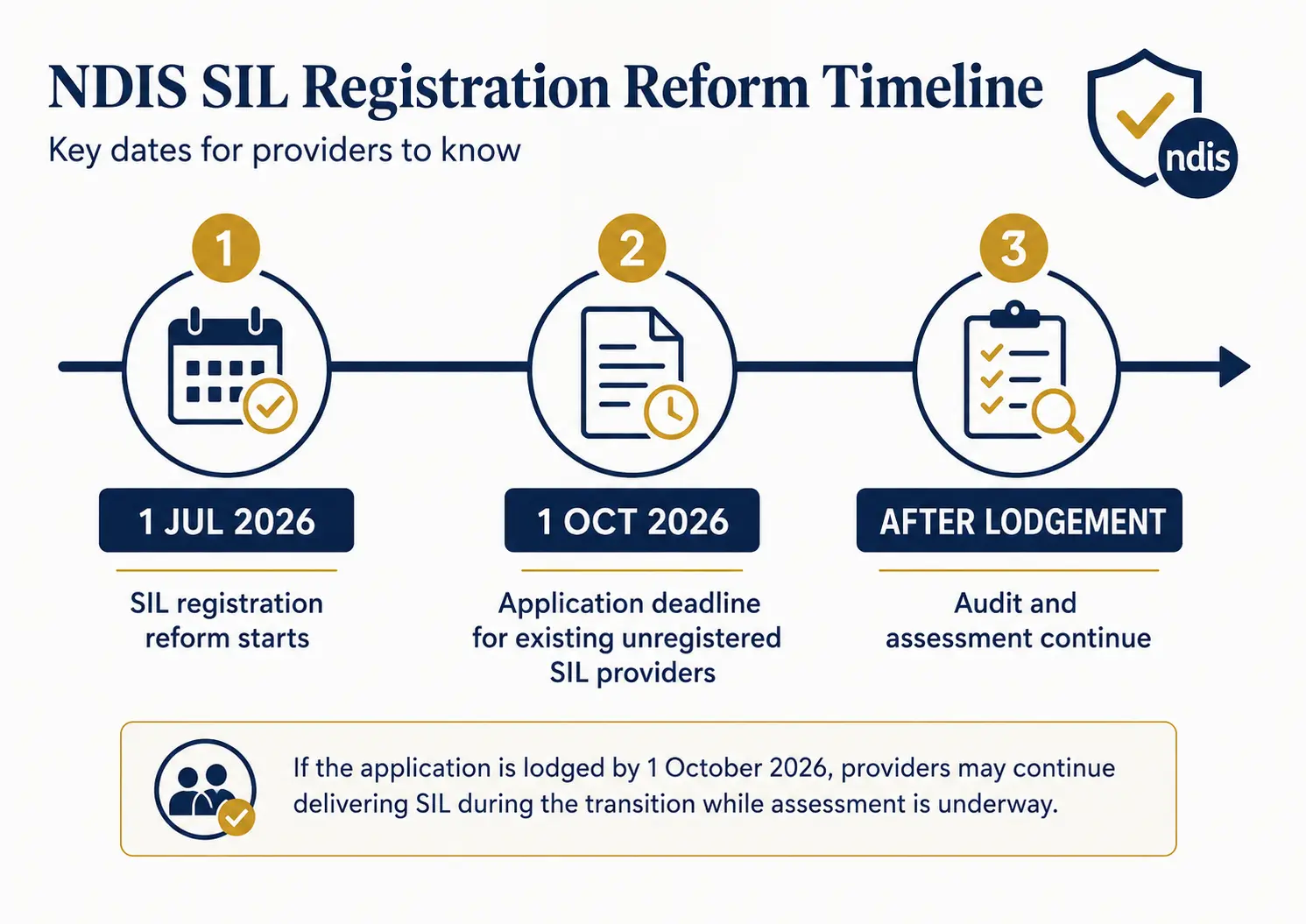
1 July 2026 is the date mandatory SIL registration commenced. The new registration group 0138 and the SIL Supplementary Module of the NDIS Practice Standards took effect on this date. This is not the application deadline. It is the date the reform became law.
1 October 2026 is the application deadline for existing unregistered SIL providers. If you were delivering SIL before 1 July 2026 and have not yet registered, you must submit a registration application by this date to continue operating during the transition period.
Providers who have not submitted an application by 1 October 2026 must stop delivering SIL. Continuing without an application in place after this date may breach the NDIS Act, with penalties of up to two years imprisonment, 120 penalty units, or both.
Can I keep delivering SIL while my registration application is being processed?
Yes, provided you submit your application before 1 October 2026. The NDIS Commission operates a transition arrangement that allows existing unregistered SIL providers to continue delivering supports while their application is being assessed, provided the application was lodged by the deadline. This is a critical point: the deadline is for submitting the application, not for completing the audit and receiving registration approval. The certification audit process takes three to six months after application, and the Commission accounts for this in its transition arrangements.
What happens if I miss the 1 October 2026 deadline?
You must stop delivering SIL. There is no grace period beyond 1 October 2026 for providers who have not submitted an application. If you are currently delivering SIL to participants, this means arranging transition of those participants to registered providers, which is a significant operational and ethical undertaking. The time to act is now, not in September.
What Registration Actually Involves
SIL requires the Certification pathway, which is the most comprehensive NDIS registration pathway. It involves a two stage audit conducted by an NDIS Commission approved quality auditor.
Stage 1: Desktop audit
The auditor reviews your documentation. This includes your policies and procedures, governance framework, incident management system, worker screening records, and evidence that your systems exist and are being used. Stage 1 is conducted remotely.
Stage 2: On-site audit
The auditor visits your operating location. They interview staff and, where appropriate, participants. They assess whether your systems are embedded in how you actually work, not just documented on paper. This distinction matters. An auditor is not looking for policies. They are looking for evidence that those policies are being followed.
The realistic timeline from starting your documentation to receiving registration approval is four to eight months. This includes four to six weeks to build your documentation and submit your application, a further four to twelve weeks for the auditor to schedule and conduct both stages, and then the Commission's assessment period.
Auditor availability is tightening. With thousands of providers needing to complete certification audits before or shortly after the October deadline, approved quality auditors are booking out quickly. Engaging an auditor early, before your documentation is complete, is a legitimate and common approach. Most auditors will schedule you provisionally and confirm once your Stage 1 documentation is ready.

Where Most Providers Are Actually Starting From
In my work with SIL providers, I encounter three typical starting positions. The path forward differs meaningfully depending on which one describes you.
You have some documents but nothing was built for audit
This is the most common situation. You have a service agreement template, possibly a privacy policy, and a basic incident report form. These documents were built for operational purposes, not for audit scrutiny. They may be adequate in practice but will have gaps against the NDIS Practice Standards. The work here is a structured gap analysis, not a complete rebuild. Identify what exists, map it against the standards, and build only what is missing.
You are operating entirely on informal systems
Some providers deliver excellent care with minimal documentation. Participant relationships are strong, incidents are managed well in practice, and workers are appropriately screened. The audit problem is not the quality of your work. It is the absence of evidence that it is happening. This starting position requires a full documentation build but benefits from strong operational knowledge to draw on. The documentation captures what is already being done, rather than designing something new.
You are already registered under another group
If you hold existing registration under a group such as Daily Personal Activities or Community Participation, you already have an approved audit and a documentation suite. Your primary task is to add the SIL Supplementary Module requirements to what exists. This is a narrower scope of work than a full registration build and, in most cases, can be completed in two to four weeks.
What the New SIL Practice Standards Actually Require
The SIL Supplementary Module adds four new standards on top of the existing NDIS Practice Standards Core Module. Here is what each one means in practice for a small operator.
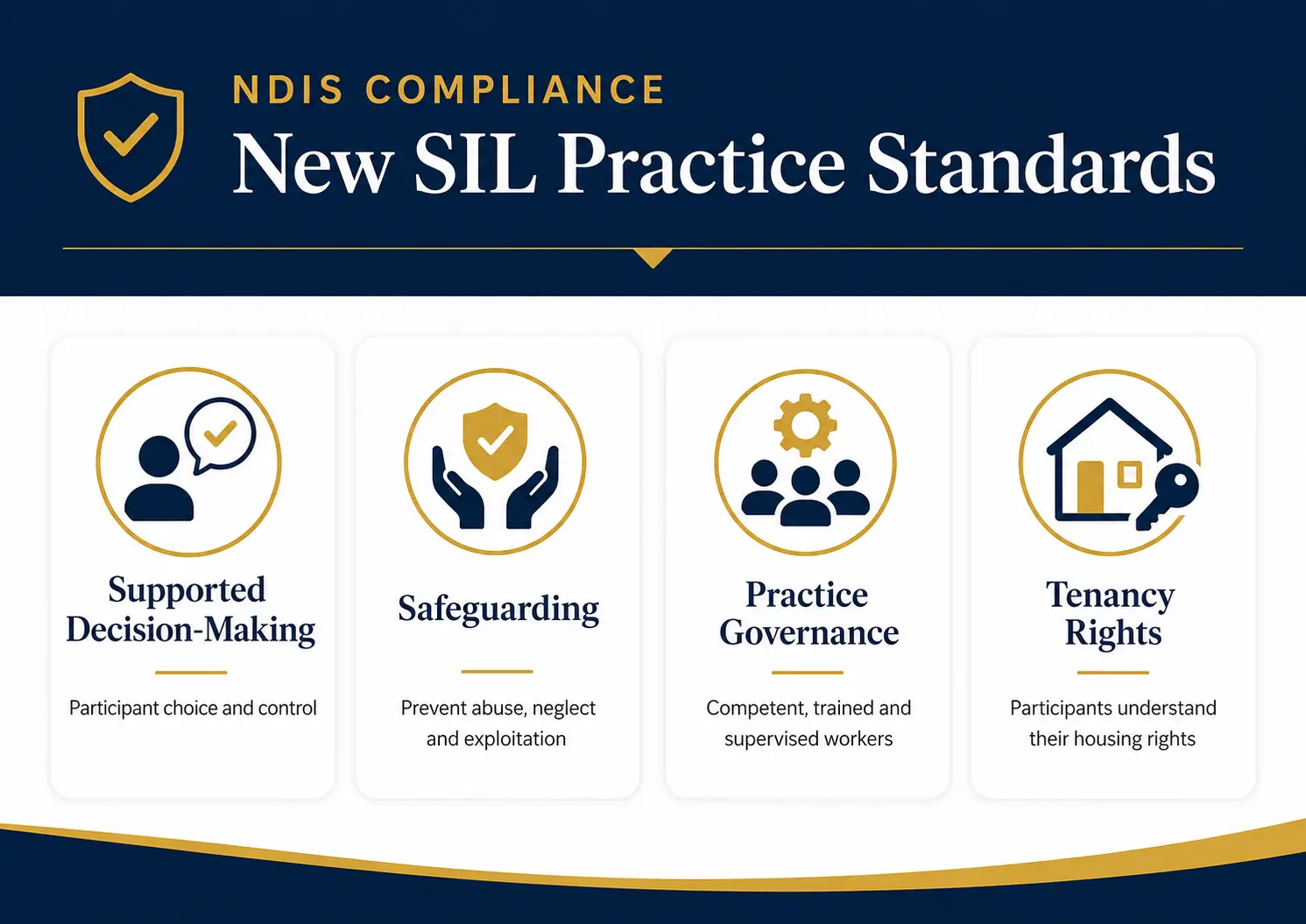
Standard 1: Supported Decision-Making
Participants must be actively supported to make decisions about their home, their daily life, their relationships, and their goals. This is not a policy on paper. It means your service agreements, support plans, and daily practices reflect that the participant is in control of their own life. Auditors will ask participants directly whether they feel they have choice and control.
Standard 2: Safeguarding
A zero tolerance position on violence, abuse, neglect, exploitation, and discrimination, balanced with respect for the participant's dignity of risk. This requires a specific safeguarding policy for the shared living context, not a generic statement. Your incident management process must reflect how safeguarding concerns are identified, reported, and resolved in a residential setting.
Standard 3: Practice Governance
Workers delivering SIL must be competent, trained, and supervised specifically for the SIL context. Overnight support, personal care in a shared home, and managing household dynamics between participants all require documented governance. Worker training records, supervision notes, and competency evidence will be sampled at audit.
Standard 4: Tenancy Rights
Participants living in SIL arrangements have tenancy rights. They must understand those rights, and your documentation must reflect that you have informed them. This is state specific: tenancy legislation varies between Victoria, NSW, Queensland, and other states. Your service agreement and participant handbook need to address the relevant state legislation.
The Realistic Timeline From Now
With today being 20 July 2026, there are 73 days until the 1 October 2026 application deadline. Here is what a realistic timeline looks like from this point.
In weeks one and two, assess where you actually stand. Conduct a gap analysis against the Core Module and SIL Supplementary Module. Identify whether you are starting from scratch, adapting existing documents, or filling specific gaps. Contact an approved quality auditor and book your audit slot, even provisionally.
From around week two to week six, build or update your documentation suite. Policies, procedures, service agreements, worker screening register, incident management system, safeguarding policy, and the four SIL Supplementary Module requirements. If you are working with a consultant, this phase runs in parallel with auditor engagement.
By around week four to six, submit your NDIS Commission registration application via the Provider Registration Portal. You do not need your audit to be complete before submitting your application. The Commission will direct you to an approved auditor as part of the application process if you have not already engaged one.
From roughly week six through to week twenty, expect the Stage 1 desktop audit, addressing any non-conformances identified, the Stage 2 on-site audit, addressing any further non-conformances, and then NDIS Commission assessment and registration determination.
The four to eight month certification timeline means that providers starting today will not receive their registration approval before October. That is expected and accounted for by the Commission's transition arrangements. What matters is that your application is submitted before 1 October 2026. Registration approval will follow the audit process.
What to Do This Week
If you have read this far and are an unregistered SIL provider, there are three things worth doing in the next five business days.
Run a basic self-assessment. List every SIL related document you currently have. Check it against the Core Module outcomes and the four SIL Supplementary Module standards. Note the gaps.
Contact an approved quality auditor. Find one at the NDIS Commission website. Ask about availability for a certification audit starting within the next six to eight weeks. Book a slot even if you are not ready yet. Availability is the binding constraint, not your documentation.
Download the free SIL Registration Readiness Checklist below. It takes 15 minutes to complete and tells you exactly where your gaps are before you speak to anyone.
Frequently Asked Questions
These are the questions I hear most often from SIL providers navigating the registration process.
How much does SIL registration cost?
The total first year cost of registration typically includes two main components: your documentation and compliance preparation, which varies significantly based on your starting position, and the certification audit fee paid to your approved quality auditor, which typically runs from $7,000 to $15,000 for a single site SIL operation. NDIS Commission registration fees also apply and vary by organisation size and support types. Registration support through CollabEdge starts from $2,000, with the exact scope confirmed after we understand your situation.
Do I need a consultant to register?
No. The NDIS Commission registration portal is accessible to any provider and the Practice Standards are publicly available. Providers with strong operational discipline and existing documentation who are already registered under another group can often self-manage the SIL supplementary module additions. Providers starting from scratch with no existing documentation, limited familiarity with the Practice Standards, or no previous audit experience are more likely to benefit from specialist support, both to ensure quality and to move faster given the time pressure.
What is the difference between registered and unregistered SIL delivery?
Before 1 July 2026, unregistered providers could deliver SIL to participants whose plans were self-managed or plan-managed. From 1 July 2026, all SIL delivery requires registration regardless of plan management type. This is the core change the reform introduces.
Can I deliver SIL to plan-managed participants without registering?
No. From 1 July 2026, plan management type is no longer a determining factor for SIL. All providers delivering SIL must be registered. The 1 October 2026 deadline for existing providers to submit their application applies regardless of the participant's plan management type.
What happens to my current participants if I do not register?
If you do not register and cannot continue delivering SIL after the transition period, you are responsible for supporting your participants to transition to a registered provider. This is an ethically significant undertaking. Participants in SIL arrangements often have complex support needs and established relationships with their provider. Transitioning them is not straightforward. This is one of the strongest practical reasons to begin the registration process now rather than waiting.
A Note on Tone
I am aware that much of the content circulating about this reform leads with urgency and consequences. That is not wrong, the deadline and the penalties are real. But in my experience, providers who feel scared make worse decisions than providers who feel informed. The registration process is manageable. The documentation requirements are clear. The timeline, while tight, is workable if you start now.
If you are unsure where to start, the checklist below is the right first step. If you want to talk through your specific situation before committing to any path, the free 30 minute call exists for exactly that purpose.
What Will This Series Cover Next?
This is Article 1 of the NDIS Compliance Series. Article 2 looks at what NDIS auditors actually look for, and why policies on paper are not enough.
NDIS Compliance Series
- 1.SIL Registration for Unregistered Providers: What Actually Needs to Happen Before 1 October 2026 (this article)
Free Resources to Help You Get Started
SIL Registration Readiness Checklist. A 15 minute self-assessment that tells you exactly where your documentation gaps are before you speak to anyone. Coming soon. In the meantime, book a free 30 minute call and bring your situation, we will tell you where you stand.
Book a free 30 minute registration readiness call: No obligation, no pitch.
Sinclair Hurtis is the founder of CollabEdge Solutions, an NDIS compliance and operations consulting firm based in Melbourne. Sinclair works directly with registered and unregistered NDIS providers on compliance documentation, audit preparation, and operational governance, including Enhance Ability Services, a SIL registered provider in Geelong, where he supports ongoing audit readiness. This article reflects direct practitioner experience, not secondary research.