
Safeguarding Your Business Data: A 10 Step Guide for Proactive Protection
By Sinclair Hurtis · 25 September 2024
Originally published September 2024. The frameworks and principles below are evergreen, and remain the foundation we use when reviewing a client's data landscape today.

Just like you protect your physical assets such as your home, securing your business data is critical to protecting your clients and your company. Data is the lifeblood of any business. Protecting it is not just good practice. It is essential for maintaining client trust, ensuring operational continuity, and safeguarding your reputation. Use this 10 step guide to self-assess your current security practices and identify vulnerabilities.
Step 1: Start With Security Standards
Think of these standards as the industry-recognised best practices for establishing a robust security framework. Are you aware of the standards and regulations your organisation needs to abide by, and the implications should there be a data breach within your company?
Globally, ISO/IEC 27001 provides a comprehensive framework for establishing, implementing and continually improving an information security management system, and the NIST Cybersecurity Framework, developed in the United States but used worldwide, offers a flexible approach to managing cybersecurity risk.
In Australia, the Essential Eight, developed by the Australian Signals Directorate, is designed to protect internet-connected information technology networks, and the Australian Energy Sector Cyber Security Framework assesses and enhances cybersecurity maturity across critical energy infrastructure.
In Singapore, the MAS Technology Risk Management Guidelines set comprehensive risk management expectations for financial institutions, and the Cybersecurity Act 2018 provides the framework for national cybersecurity oversight.
Recommended next steps
Start with a gap analysis assessing your current security controls against the standards that apply to you, a security health check that identifies areas for improvement. Treat implementation as more than checking boxes for regulatory compliance. The goal is a security-conscious culture across your organisation. If you would like an independent map and gap assessment of your data landscape, book a conversation.
Step 2: Ensure Data Privacy Compliance
Data privacy laws are getting stricter every year. You need to keep your customers' data safe while still using it to grow your business.
Globally, the GDPR mandates strict privacy measures for any company handling the personal data of EU citizens.
In Australia, the Privacy Act 1988 is the foundational legislation shaping how personal information is handled, and it has recently been strengthened, with further tranches of reform underway. The Australian Privacy Principles, thirteen principles in total, cover Australian Government agencies and organisations with an annual turnover above $3 million, with exceptions detailed on the OAIC website.
In Singapore, the Personal Data Protection Act regulates the collection, use and disclosure of personal data.
Recommended next steps
Laws and regulations can seem theoretical and easy to put off. Think again. What would be the consequence if your data were breached? Could you afford the fines, and what would it do to trust in your business? AI tools can genuinely streamline the review process, summarising legislation and producing digestible reference material, provided you de-identify any sensitive business or client content before it goes into an external tool. If you would like help reviewing your data landscape, reach out today.
Step 3: Implement Robust Data Encryption
Encryption turns your data into a code that only you can crack, your first line of defence against attackers. It scrambles your data, making it unreadable without the decryption key.
Use advanced encryption methods such as AES-256 and RSA for data at rest and in transit, and make encryption a standard practice for all sensitive data. This AWS guide is a useful reference on encryption best practice.
Recommended next steps
Before engaging external parties, review your existing technology stack and licences. Many businesses are already paying for encryption capability they are not using. Review the people and process aspects before embarking on full scale technology implementations.
Step 4: Access Control and Identity Management
Robust access control and identity management are the vigilant gatekeepers of your digital assets, ensuring only authorised personnel can access sensitive information, and only through secure channels. The key question: how do you reduce insider threats and limit exposure to external attacks?
Recommended next steps
Limit access on the principle of least privilege, where only those who need access have it. Implement role based access control and multi-factor authentication as your key pillars, and run continuous education with mandatory refresher training across your entire employee population.
Step 5: Regular Security Audits and Vulnerability Assessments
Just as you go for regular health checkups, your systems need them too. The key message: do not wait for a breach to happen. Be proactive and find the vulnerabilities before the bad actors do.
Recommended next steps
Conduct regular security audits and vulnerability scans to identify and fix gaps. Consider a guided questionnaire that business and technology application owners complete quarterly or half yearly. And bring in a third party penetration tester periodically, a friendly attacker who breaks in so you can fix the weak spots first.
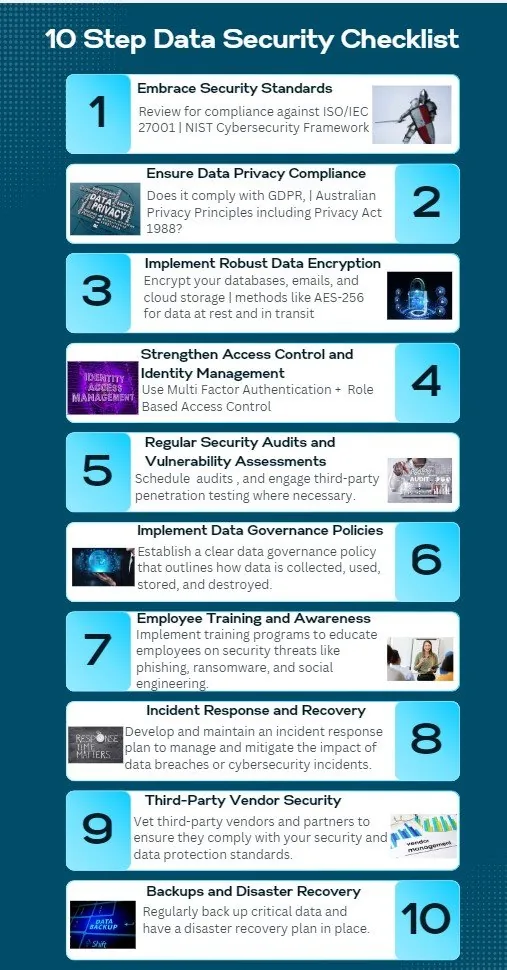
Step 6: Data Governance Policies
Data governance is the rulebook for your data. Knowing where it is, who is using it, and how it is being handled. In my experience this is one of the most critical steps, because it sets the policy, framework and tools for every area of data management. It is also by far the hardest to implement. Try asking a floor of analysts to move from Excel macros to a business intelligence tool integrated with your master data. Easier said than done.
Recommended next steps
Secure sponsorship and commitment from the top, with every unit head understanding why governance matters and committing to it. Use an industry framework such as DMBOK so the whole organisation shares definitions and terminology. Implement changes incrementally using agile and hybrid approaches, with KPIs that monitor progress and demonstrate return. And set clear roles and responsibilities, because data governance works best when it is business led, not technology led.
Step 7: Employee Training and Awareness
Your employees are your first line of defence. They can also be your weakest link. Education across your organisation is key to the success of any data governance strategy.
Recommended next steps
Run regular training sessions and simulated phishing exercises to assess and improve awareness. Invite government bodies to share real scam statistics so everyone understands the genuine threat a breach poses to the company and to their own job security.
Step 8: Incident Response and Recovery
No matter how good your security is, there is always a chance something goes wrong. Have a plan B.
Recommended next steps
Do not just have a plan. Test it regularly, so everyone knows their role when a breach occurs, the same way you practise an emergency evacuation before the alarm goes off. Pair that with proactive monitoring: a defined set of data metrics, reported regularly to key stakeholders, so decisions are driven by data rather than surprises.
Step 9: Third Party Vendor Security
You might be doing everything right, but what about your vendors and partners? Your security is only as strong as its weakest link, and third parties can introduce vulnerabilities if their practices are lax. Trust, but verify.
Recommended next steps
Vet vendors and partners against your security and data protection standards. Review contracts thoroughly before signing, with a dedicated review checklist. And conduct ongoing audits focused on the areas in this guide. Has the vendor's platform undergone recent penetration testing? What does their disaster recovery planning look like?
Step 10: Backups and Disaster Recovery
Backups are insurance for your data. If something goes wrong, you restore and get back to business. Regular backups and a well defined disaster recovery plan are essential for continuity in the face of unforeseen events.
Recommended next steps
Schedule automatic backups of critical data and test recovery procedures periodically so data can be restored quickly. Conduct annual business continuity exercises involving all key business units, document adverse findings, and follow through on mitigations. Include progress on those action items in your regular service delivery and operations reporting.
Wrapping Up
Data security is not a one time exercise. It is an ongoing process, like staying in shape. You need to keep working at it. With the right mindset and the right tools, you can protect your business and your customers' data.
If you would like a second set of eyes across your security posture, book a free 30 minute consultation. No sales pitch, just a practical conversation about where you stand.
Sinclair Hurtis is a data and analytics professional with three decades of experience across information management, data and analytics, and workflow process automation, gained in both consulting and end client environments across Australia and Asia Pacific. Read more about Sinclair.