
AI and NDIS Documentation: What Is Safe, What Is Risky, and What Actually Works
By Sinclair Hurtis · 15 July 2026
This article publishes as the NDIS Commission releases its own AI transparency statement, confirming it is already using large language models to process complaints, incidents and audit reports. If the regulator is using AI on your documentation, the question is no longer whether AI belongs in NDIS services. The question is whether you are using it safely.
It is a Tuesday afternoon. You have a complex Change of Circumstances report due by Friday.
You open ChatGPT, paste in your case notes, and ask it to help you structure the report.
It produces something useful in about forty seconds.
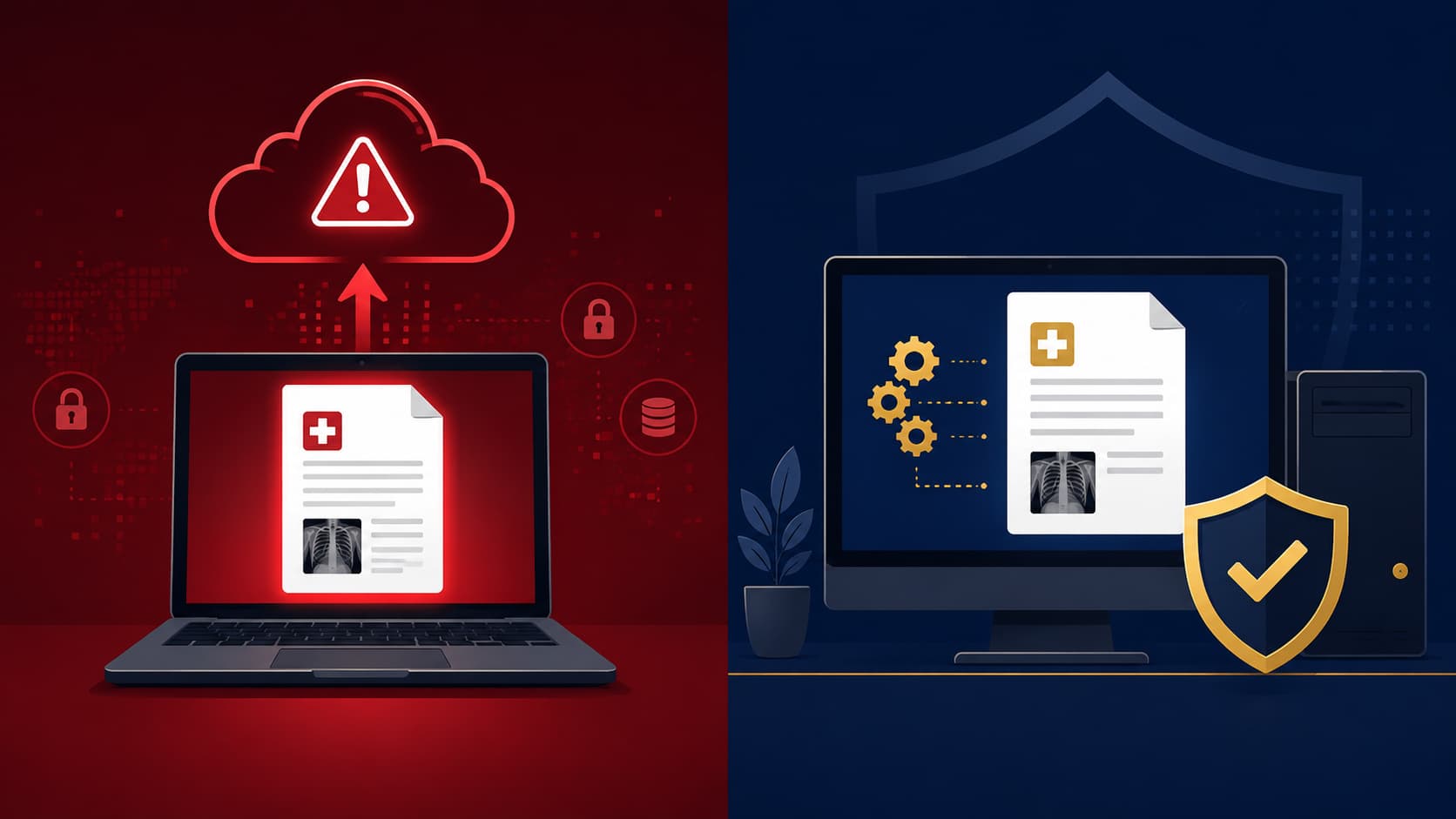
What you may not have considered is where those case notes went. The participant's name. Their NDIS number. Their diagnosis. Their family situation. Their address. All of it, sent to servers in the United States, processed by a platform with no specific agreement covering health information under Australian law.
You have just created a notifiable data breach.
Not intentionally. Not carelessly. But under the Privacy Act 1988 and the NDIS Practice Standards, intent is not the test. Disclosure is.
This is the article many practitioners wish existed eighteen months ago, before this problem became one worth solving properly.
Is Using AI for NDIS Documentation Actually Legal?
The short answer is that it depends entirely on what data you put into it and where that data goes.
When you paste participant information into a public AI tool like ChatGPT, that data is sent to servers overseas. Depending on your account settings, it may be used to improve the platform's models. There is no isolation between your organisation and every other person using the same platform.
NDIS providers in Australia are subject to strict privacy obligations under both the Privacy Act 1988 and the NDIS Practice Standards, requiring robust handling of participants' sensitive personal information.
The NDIS Commission does not currently have AI specific rules for providers. But the existing framework is clear enough. Australia does not yet have AI specific laws. Instead, existing frameworks apply. Providers must protect personal information under the Privacy Act, avoid misleading or unfair practices under consumer law, and ensure AI systems do not discriminate.
What this means practically is that using AI for NDIS documentation is not prohibited. Using AI with identifiable participant data on public platforms is.
The legal test that matters: Under the Privacy Act 1988, health information is classified as sensitive information requiring a higher standard of protection. The moment a participant's name, NDIS number, diagnosis, address or family details reaches an external platform without explicit consent and a formal data processing agreement, you have a compliance problem regardless of the outcome.
A notifiable data breach must be reported to the Office of the Australian Information Commissioner and affected individuals promptly. The consequences can include compliance notices, banning orders and cancellation of NDIS registration.

What Is Shadow AI and Why Is It the Real Risk for NDIS Providers?
Most NDIS providers do not have a formal AI policy. That does not mean their staff are not using AI. It means they are using it without oversight.
There is the risk of shadow AI, where staff use tools like ChatGPT on their own without management oversight. This creates unmanaged risks that can turn into real liability if things go wrong. If staff share participant data into public systems, this can breach privacy obligations and the NDIS Code of Conduct.
The provider carries that liability. Not the staff member who opened ChatGPT on their lunch break.
Three shadow AI scenarios that happen in NDIS practices right now:
The well meaning support worker pastes progress notes into ChatGPT to clean up the grammar before submitting. Participant names and support details go with it.
The time poor coordinator uploads a participant's assessment PDF to an AI tool to extract key dates and goals. The PDF contains everything.
The practice manager uses an AI transcription tool during team meetings where participant cases are discussed by name. The transcription service stores the audio.
None of these people intended to breach privacy. All three created a reportable incident.
What Are the Different Types of AI Tools and Which Are Safe?
Not all AI tools carry the same risk. The determining factor is not the brand name. It is the data architecture underneath.
Public AI tools are high risk with participant data. Tools like ChatGPT on standard accounts, Google Gemini and Microsoft Copilot on personal accounts process your inputs on shared infrastructure. Your data may be used to improve the model. There is no formal data processing agreement in place for health information. These tools are not inherently unsafe. They are unsafe when participant data goes into them.
Closed AI tools carry lower risk with de-identified data. Google NotebookLM is an example of closed AI. It only works against trusted sources and websites that you upload. It cannot reach outside the documents you give it. Every answer it generates cites back to your uploaded sources. This makes it far more defensible for NDIS documentation work, provided the documents you upload do not contain identifiable participant information.
Enterprise or sector specific AI tools carry the lowest risk of the paid options. Platforms built specifically for NDIS with formal data agreements, Australian data hosting and audit trails sit at the lower end of the risk spectrum. They typically come at a cost and require implementation work. For large providers, this is the right direction. For sole traders and small practices, the economics rarely stack up.
Local processing carries no network risk at all. Tools that run entirely on your own computer, with no internet connection required for processing, carry the lowest data risk of all. The data never leaves your device. There is no API call, no cloud upload, no third party server involved.
What Does a Careful AI Workflow for NDIS Documentation Actually Look Like?
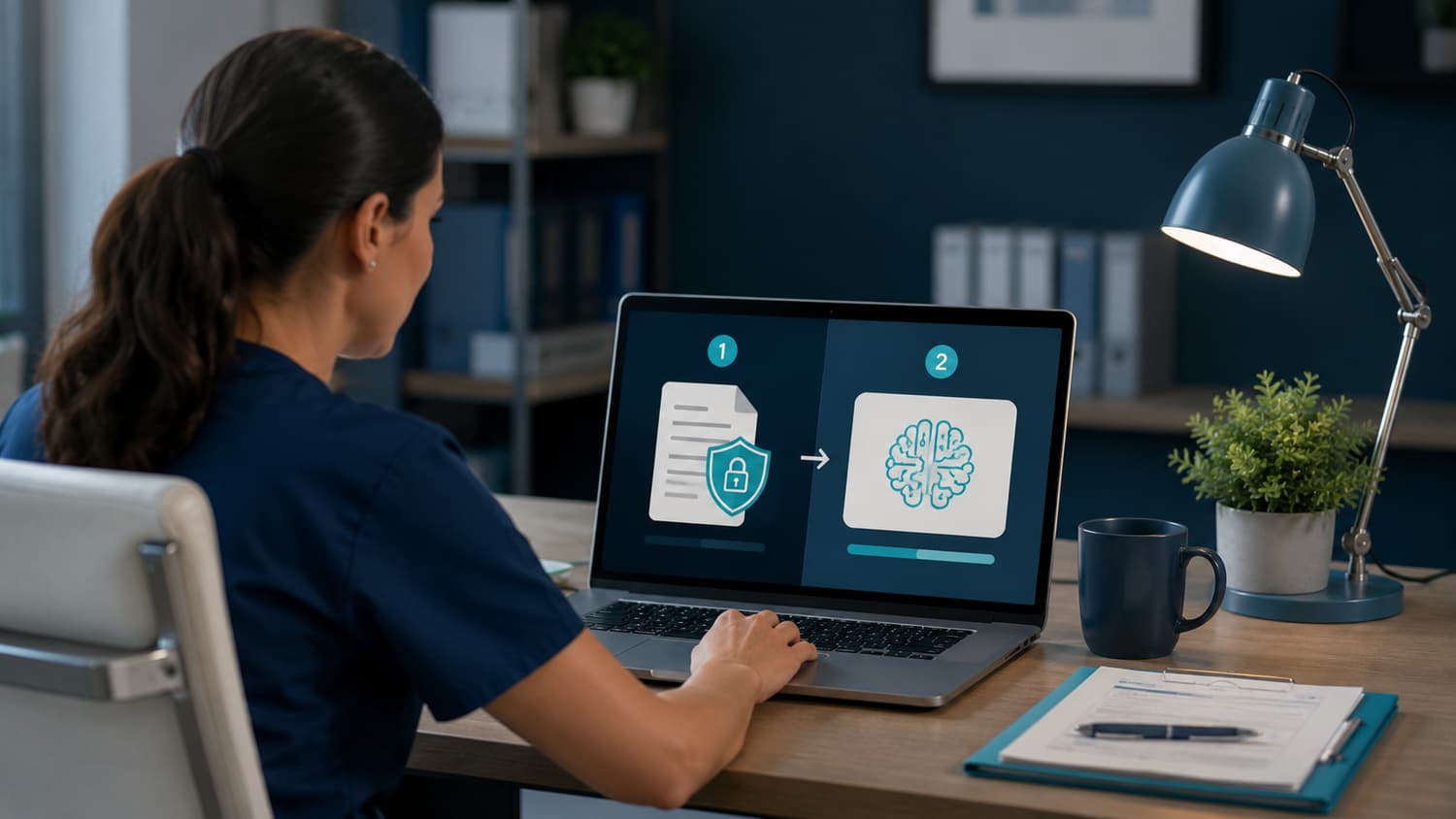
This is a workflow that works well on complex reports including Change of Circumstances, behaviour support plans and functional assessments.
It has two steps. The sequence matters.
Step 1: De-identify before anything goes near AI. Before a clinical document touches any AI tool, remove every piece of personally identifiable information. This includes participant names, NDIS numbers, dates of birth, addresses, family member names, provider names, school and clinic names, and any other detail that could identify the individual. Done manually, this takes fifteen to twenty minutes per document and introduces human error. Done with a purpose built de-identification tool, it takes under sixty seconds and is consistent every time. The de-identified document is now safe to process through any AI tool, because there is no participant data in it.
Step 2: Use closed AI against the de-identified document. Upload the de-identified document to NotebookLM alongside any relevant NDIS legislation, practice standards or policy documents you want the AI to reference. Ask it to draft sections of your report. Every answer it gives you cites back to the sources you uploaded. It cannot hallucinate beyond what you gave it, because it cannot access anything else. Review, apply your clinical reasoning, re-personalise the output with the participant's details, and verify before submitting.
The result is a fully defensible, citation backed draft. Two hours instead of eight on a complex report. Participant data never left your computer.
How Does the NDIS Commission View AI in 2026?
The NDIS Commission published its own AI transparency statement in February 2026. The Commission is already using large language models to process text documents including complaints, reportable incidents and audit reports. It states it is committed to using AI in a safe, responsible and transparent way, with human oversight maintained at all times. Information is processed in a secure internal environment.
The significance of this for providers is twofold.
First, the regulator has signalled that AI in NDIS administration is legitimate and expected, provided it is governed properly.
Second, the bar for what properly governed looks like is rising. There is a clear move towards more oversight, more frameworks, and sharper accountability. Providers that prepare now will be better placed to comply when rules tighten.
In December 2025, the National AI Plan confirmed that Australia will rely on existing laws and sector regulators, supported by voluntary guidance and a new AI Safety Institute, rather than introducing a standalone AI Act or immediate mandatory guardrails. That will not remain the position indefinitely.
From 10 December 2026, new obligations under the Privacy and Other Legislation Amendment Act 2024 will require organisations to disclose in their privacy policies the types of personal information used in substantially automated decisions.
If you are using AI in your documentation workflow, you will need to address this in your privacy policy before the end of 2026.

What Should an NDIS Provider's AI Policy Actually Cover?
You do not need a 40 page document. You need a clear, practical policy that your staff can actually follow.
Providers should avoid inputting identifiable participant data into AI tools unless essential. All use of AI systems must align with the Privacy Act 1988 and all relevant industry standards, rules, or codes. Providers must inform participants when an AI system is used and provide alternatives where possible. Providers have a duty to only utilise secure platforms and restrict access to trained staff.
The five things a minimum viable AI policy needs to cover:
Approved tools: A list of AI tools staff are permitted to use and the conditions under which they can be used.
Data handling rules: An explicit prohibition on inputting identifiable participant data into any tool not covered by a formal data processing agreement.
De-identification requirement: A requirement that participant data be de-identified before AI processing, with a documented method for doing so.
Human oversight: A requirement that AI generated content is reviewed, verified and approved by a qualified practitioner before use.
Transparency obligation: A commitment to inform participants when AI has been used in the preparation of their documentation.
This does not need to be complicated. It needs to be written down and followed.
What Will This Series Cover Next?
This is Article 5, the final article in the NDIS Productivity Series. The full series covers the ethical operator's dilemma and why productivity now matters more than ever (Article 1), what the May 2026 budget really means for small providers (Article 2), the productivity paradox and why doing more manually is hurting participant care (Article 3), seven practical productivity wins for NDIS providers (Article 4), and this article on AI and NDIS documentation.
The NDIS Productivity Series
- 1.The Ethical Operator's Dilemma: Why NDIS Productivity Matters More Than Ever in 2026
- 2.What the May 2026 NDIS Budget Really Means for Small Providers
- 3.The Productivity Paradox: Why Doing More Manually Is Hurting Participant Care
- 4.Seven Practical Productivity Wins for NDIS Providers
- 5.AI and NDIS Documentation: What Is Safe, What Is Risky, and What Actually Works (this article)
Want to Use AI Carefully in Your Practice Right Now?
If you are an NDIS or Allied Health provider and you want to start using AI in your documentation workflow today, here is where to begin.
Try MedPrivacy free for 30 days: A local de-identification tool built for NDIS documentation, so participant data never leaves your device before it reaches an AI tool.
Book a free 30 minute consultation: No sales pitch. A conversation about where your practice stands and what careful AI use would actually look like for your team.
Sinclair Hurtis is an active NDIS Support Coordinator, partnering with My Ability Services in Melbourne, and the founder of CollabEdge Solutions. He builds practical tools for ethical NDIS providers, starting with the problems he encounters in his own practice.