What the May 2026 NDIS Budget Really Means for Small Providers (Updated 12 May)
The budget has now landed. The pre-budget signals were confirmed and the scale is significant. $36.2 billion in savings over four years, 160,000 participants transitioning off the scheme by 2030, and nearly 200 new compliance staff added to the NDIS Quality and Safeguards Commission. The analysis below remains accurate. Key confirmed dates and figures have been updated throughout.
This article was published before the 2026-27 federal budget on 12 May. The pre-budget signals it described have now been confirmed. The government will recoup $36.2 billion by curbing the NDIS growth over the next four years. Participant numbers will reduce from 760,000 to approximately 600,000 by 2030. If you are waiting to start preparing, you are already behind. Here is what was confirmed, what it means for small providers, and what you can do about it right now.

The May 2026 federal budget confirmed $36.2 billion in NDIS savings. The largest single measure in the entire budget.
It is Sunday evening. You have been reading the NDIS coverage all week.
Participant budgets are being reset. Support coordination is moving to a commissioned model. Unregistered providers face new registration requirements. The headlines are loud and the details are thin.
If you run a small NDIS practice, a sole trader operation, or an allied health service with NDIS participants, you are probably asking one question: what does any of this actually mean for my practice on Monday morning?
This article strips out the political noise and focuses on what has been confirmed, what it means for small providers specifically, and what the ethical operators in this sector should be doing right now, before the impact lands.
What Has the Government Actually Confirmed in the Budget?
The 2026-27 federal budget confirmed the largest single savings measure in the entire budget: $36.2 billion in NDIS savings over four years. Legislation to begin the overhaul was introduced the same week.
The five confirmed changes that matter most for small providers:
Participant budget reductions: The scheme will reduce from 760,000 participants to approximately 600,000 by 2030. That is 160,000 people transitioning off the scheme over four years.
Participant payment plateau: Payments made to participants will plateau at between $53 billion and $54 billion per year until 2030, down from a trajectory that had been heading toward $95.8 billion by 2034-35.
Plan reassessment restrictions: Unscheduled plan reassessments will be restricted to exceptional circumstances only. This was confirmed as a "major driver" of spending growth and will be addressed in legislation immediately.
Mandatory registration expansion: The NDIS Quality and Safeguards Commission will gain nearly 200 new staff as registration requirements widen. The NDIA simultaneously loses 669 staff positions. Less administrative support. Significantly more compliance enforcement.
New standardised assessment tool: A new tool to determine NDIS access will be in place from 1 January 2028. From that date, access relies entirely on functional needs assessments rather than diagnosis-based criteria.
Why Are Participant Budgets Being Cut and What Does It Mean for Providers?
The scheme's cost grew by more than 10.3 per cent last year. Without changes, it had been projected to support more than one million participants by 2033 and cost $95.8 billion in 2034-35. The government has confirmed this trajectory is unsustainable.
The Thriving Kids program for children under nine with autism and developmental delays will begin rolling out from October 2026, fully operational from January 2028. Children in this cohort will transition to state-based foundational supports rather than the NDIS.
What this means for small providers?
Providers whose participant cohort includes children under nine with autism or developmental delays face a direct reduction in their caseload as these participants transition to state programs. The adjustment is not optional.
From 1 October 2026, budgets for social, civic and community participation supports and capacity building daily activities will be progressively adjusted. The government has confirmed essential core supports including personal care, daily living, disability accommodation and transport are protected.
The providers best placed to absorb this change are those who have already diversified their service mix toward core supports, those whose documentation and compliance systems are strong enough to withstand tighter auditing, and those whose operational costs are lean enough to remain viable at lower billing volumes.
The ethical note: The cuts are targeted at excess and fraud, not at quality providers. But the regulatory response does not differentiate between good operators and poor ones. Tighter rules tighten on everyone equally.
What this means for small providers:
Providers whose service mix is weighted toward community participation activities face a direct revenue reduction as participant budgets in this category shrink. The adjustment is not optional and it is not negotiable.
The providers best placed to absorb this change are those who have already diversified their service mix toward core supports, those whose documentation and compliance systems are strong enough to withstand tighter auditing, and those whose operational costs are lean enough to remain viable at lower billing volumes.
Providers who have been running manual administration systems, loose documentation habits, and high overhead relative to billing volume will feel this first.
The ethical note: The cuts are targeted at excess and fraud, not at quality providers. But the regulatory response does not differentiate between good operators and poor ones. Tighter rules tighten on everyone equally.
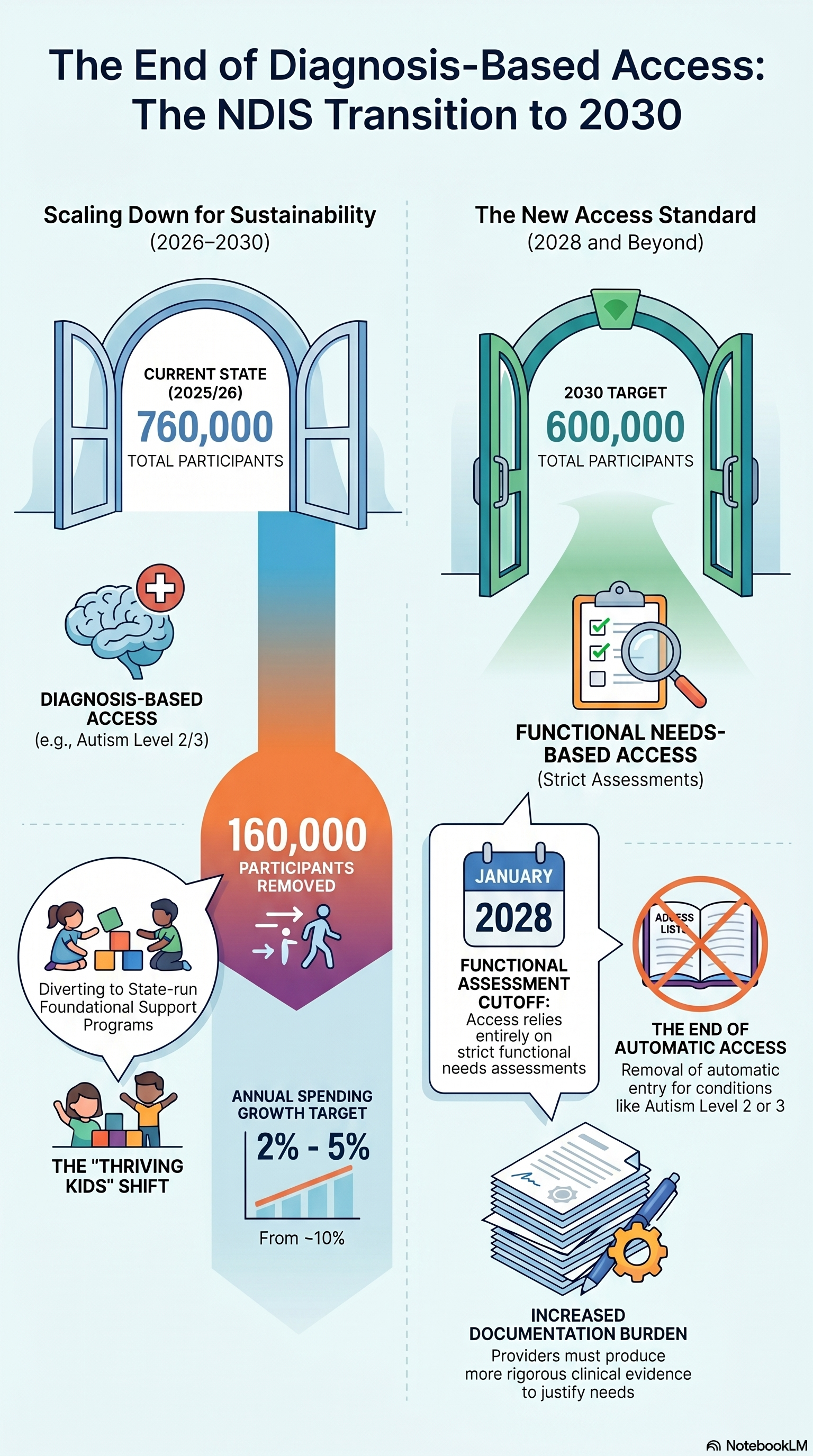
From 760,000 participants today to a 2030 target of 600,000. The transition to functional needs-based access increases the documentation burden on every provider still in the scheme.
What Does the Compliance Shift Mean in Practice?
This is the number that has received the least attention in the media coverage but matters most for registered providers.
The NDIA loses 669 staff. The NDIS Quality and Safeguards Commission gains nearly 200.
This is not a rounding error. It is a deliberate structural shift. The agency that processes your claims and supports participants is being cut. The agency that audits your practice and enforces registration requirements is being expanded significantly.
For providers doing the work properly, this is ultimately good news. The operators currently undercutting the market by delivering poor quality services without proper registration will face a much higher likelihood of enforcement action. That levels the playing field.
But it means the bar for what "doing the work properly" looks like is rising. Documentation quality, incident management, staff compliance records and audit readiness are no longer nice to have. They are survival requirements.
What Does the Support Coordination Commissioning Model Mean in Practice?
The government has confirmed it will commission a panel of plan management providers and a new support coordination function. Participants will still have choice, but within a government-vetted approved list.
The new plan management commissioning model begins from 1 October 2027 with a six-month transition period. The new support coordination function follows from 1 July 2028.
This is not happening immediately. But the direction is confirmed and the timeline is set.
Why Is Mandatory Provider Registration Expanding and Who Does It Affect?
The NDIS Quality and Safeguards Commission gains nearly 200 new staff specifically to enforce widening registration requirements. This is the clearest signal yet that the compliance crackdown on unregistered and low-quality providers is moving from rhetoric to enforcement.
From 1 July 2026, mandatory registration begins for Supported Independent Living providers and platform providers. From July 2027, registration requirements broaden to providers delivering personal care and daily living supports.
The practical upside for registered providers:
The providers currently undercutting the market by operating without registration costs will face a choice: register and meet the standard, or exit the scheme. For providers doing the work properly, this levels the playing field.
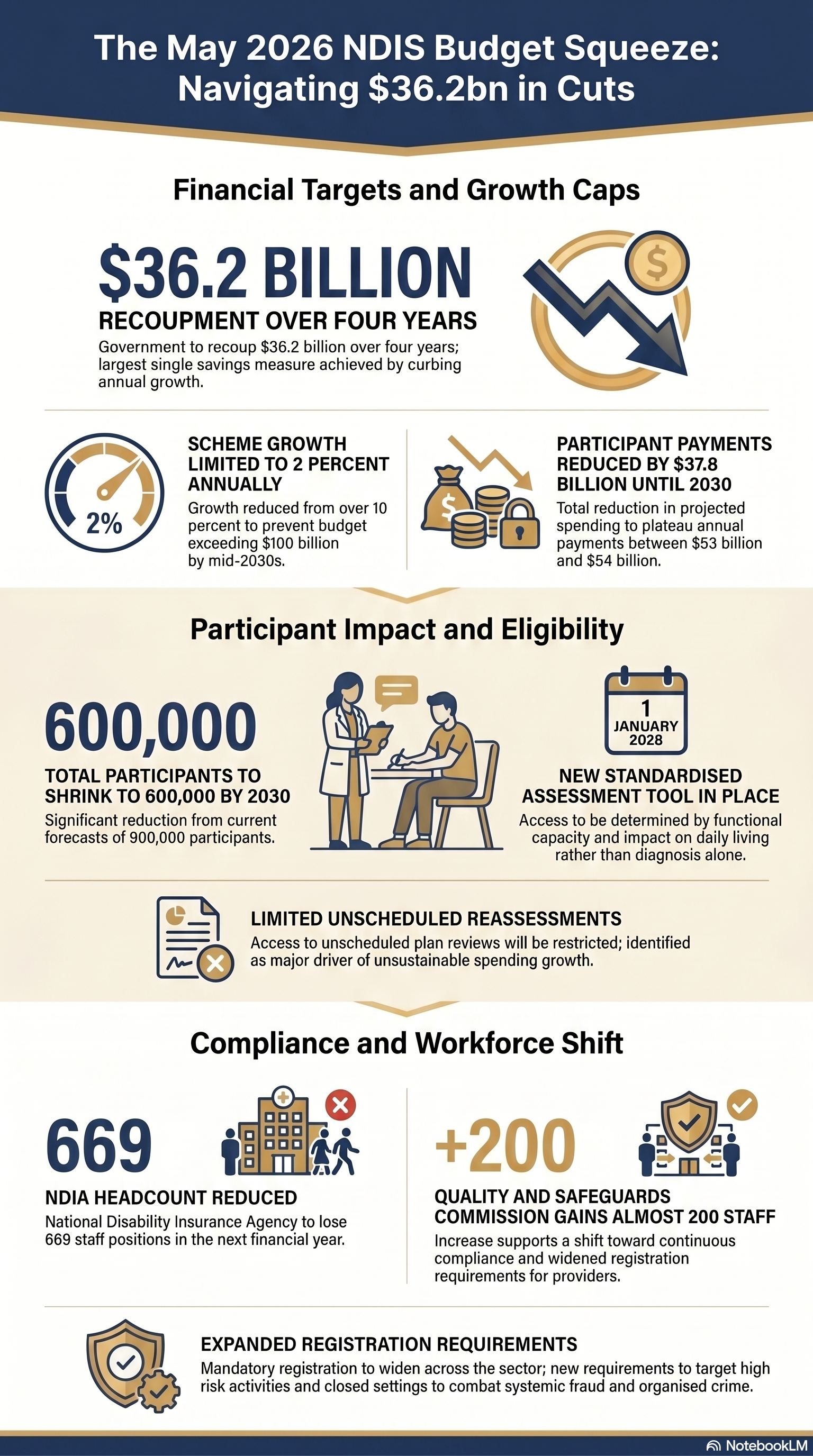
The NDIS Quality and Safeguards Commission gains nearly 200 new staff. Compliance enforcement is increasing, not decreasing.
What Should Small Providers Actually Do Right Now?
The budget is confirmed. The changes are legislated. Here is what the ethical operators in this sector should be doing now.
Audit your service mix:
Look at what proportion of your current billing comes from social and community participation supports and children under nine. If it is significant, model what the transition looks like for your revenue. Plan the gap before it arrives.
Review your documentation systems:
The commissioned support coordination model will favour providers with clean, verifiable documentation of practice quality and participant outcomes. If your case notes, service agreements and incident records are not audit-ready today, start there.
Check your registration status:
If you are unregistered and delivering supports that fall within the expanding mandatory registration categories, understand your timeline and start the registration process. Do not wait for enforcement to begin.
Reduce your administrative overhead:
Every hour spent on manual documentation, compliance spreadsheets and chasing paperwork is an hour not delivering services. The providers who survive margin compression are those who spend the least time on administration relative to their billable hours.
Build your compliance evidence base:
The expanded NDIS Quality and Safeguards Commission will require demonstrated quality. Your systems need to be producing evidence, not just activity.
What Will This Series Cover Next?
This is Article 2 of the NDIS Productivity Series. The full series:
Article 1: The Ethical Operator's Dilemma: Why NDIS Productivity Matters More Than Ever in 2026. [Read here]
Article 2: What the May 2026 NDIS Budget Really Means for Small Providers. You are reading it.
Article 3: The Productivity Paradox: Why Doing More Manually Is Hurting Participant Care. Coming soon.
Article 4: 7 Practical Productivity Wins for NDIS Providers in 2026. Coming soon.
Article 5: AI and NDIS Documentation: What Is Safe, What Is Risky, and What Actually Works. Coming soon.
Need Help Getting Your Practice Budget-Ready?
If the pre-budget announcements have raised questions about where your practice stands, here is where to start.
👉 [Book a free 30-minute consultation] : No sales pitch. A conversation between practitioners about what your practice needs to address the future direction the NDIS is heading towards.
👉 [Learn how MedPrivacy protects your practice]: If you are using AI for documentation, make sure you are doing it safely and compliantly.
--—————————-
Sinclair Hurtis is an active NDIS Support Coordinator (partnering with My Ability Services in Melbourne) and the founder of CollabEdge Solutions. He builds practical tools for ethical NDIS providers, starting with the problems he encounters in his own experiences