The Productivity Paradox: Why Doing More Manually Is Hurting Participant Care
This article publishes in the week after the 2026-27 federal budget confirmed a 30 per cent reduction target for support coordination spending. The government has signalled that fewer coordinators will be funded across fewer participants. The ones who remain will need to do more, with less, without compromising the quality of care. That is not a future problem. It is already happening. This article is about why doing more manually is making it worse.

Every hour spent on manual administrative tasks is an hour not spent with a participant. The paradox is that doing more paperwork often means delivering less care.
It is 4pm on a Thursday.
You have three participants who need callbacks. One is waiting on a funding decision that has been delayed for six weeks. Another has had a Change of Circumstances submitted that has not been actioned. The third has lodged a Request for Review of a Decision that you are still preparing supporting evidence for.
None of these callbacks are billable at your actual time cost. All of them are urgent. All of them are sitting behind a four-hour block you spent this morning on documentation, spreadsheets and chasing NDIA delegates who did not return your calls.
This is the productivity paradox in NDIS support coordination.
The harder you work on the system, the less time you have for the people the system is supposed to serve. And the budget just made that harder.
What Is the NDIS Productivity Paradox?
The productivity paradox in NDIS work is the gap between activity and outcome. Coordinators, providers and allied health practitioners are working longer hours than ever. But a growing proportion of those hours are going into administrative tasks that do not directly improve participant outcomes.
The paradox is this: the more time you spend doing things manually, the less productive you actually are for your participants. And the less productive you are for your participants, the more at risk your practice becomes in an environment that is about to demand higher quality evidence of outcomes for less funding.
Manual administration is not just inefficient. It is a clinical and compliance risk. A coordinator who is drowning in RORD paperwork at 9pm cannot give a participant the considered, informed response they deserve at 10am the next morning.
What Are RORD, COS and ART and Why Do They Take So Long?
These three processes represent the heaviest administrative burden in support coordination. Each one is legitimate, necessary and extraordinarily time-consuming when managed manually.
RORD: Request for Review of a Decision
A RORD is lodged when a participant believes an NDIA decision about their plan or funding is incorrect. As a Support Coordinator, your role is to help gather the evidence, frame the request and advocate for the participant through the review process.
Done properly, a RORD requires reviewing the original decision, identifying the legislative basis for challenging it, gathering supporting evidence from allied health practitioners and other providers, drafting a structured submission and following up through the NDIA's review pathway.
Time cost per RORD: between four and twelve hours depending on complexity. Billable hours recovered: rarely the full amount.
COS: Change of Situation / Circumstances
A Change of Circumstances submission is required when a participant's needs change significantly enough to warrant a plan review outside the scheduled reassessment cycle. Given the budget has now restricted unscheduled reassessments to exceptional circumstances only, the bar for what constitutes a successful COS has just risen significantly.
A well-evidenced COS requires updated functional assessments, clinical letters, provider reports, a structured narrative connecting the changed circumstances to the funding request and a clear articulation of why the change is reasonable and necessary under NDIS guidelines.
Time cost per COS: between three and eight hours. Often more for complex participants.
ART: Administrative Review Tribunal
When a RORD is unsuccessful, the next step is the Administrative Review Tribunal. This is a formal legal process. The preparation required is extensive: written submissions, evidence bundles, witness statements and, in many cases, legal support.
For a Support Coordinator managing this alongside a full caseload, an ART matter can consume days of work over weeks or months.
Time cost per ART matter: highly variable but routinely exceeds twenty hours of coordinator time.
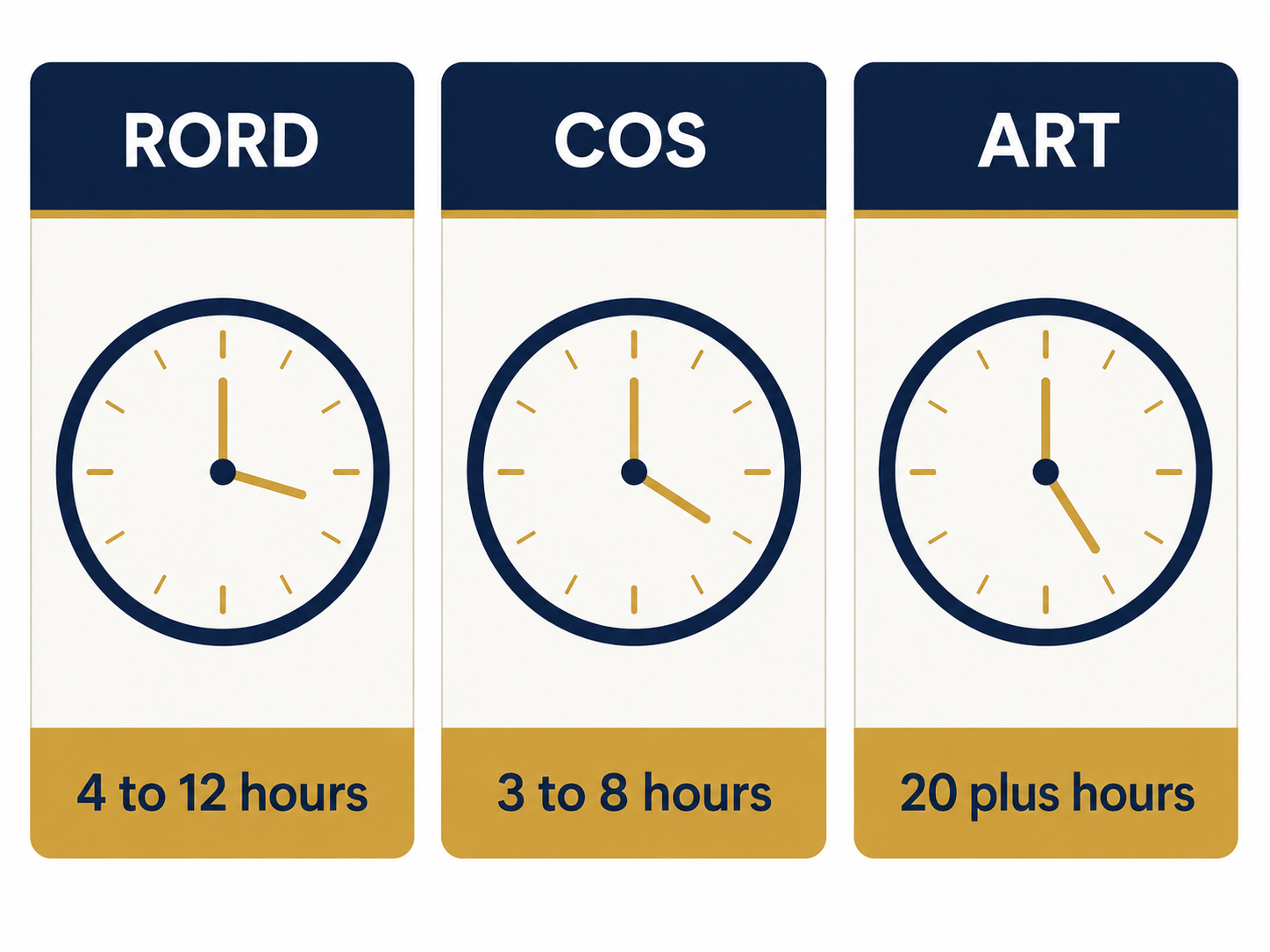
Three of the most common support coordination tasks. None of them are quick. All of them are essential. The question is how much of that time is being spent on process rather than substance.
Why Does Doing More Manually Make Things Worse?
The instinct when workload increases is to work harder and longer. In NDIS support coordination, that instinct is actively counterproductive.
Here is why.
Manual processes introduce error. A COS submission drafted from memory, pulling information from multiple spreadsheets, email threads and paper files, is more likely to contain inconsistencies than one built from a structured, complete record. NDIA delegates look for inconsistencies. A single factual error in a COS can result in a refusal that requires a RORD, which adds another four to twelve hours of work to fix a mistake that a better system would have prevented.
Manual processes cannot scale. A coordinator managing fifteen participants can absorb the administrative overhead of one RORD per month. The same coordinator managing twenty-five participants, which is increasingly common as practices try to remain viable under tighter margins, cannot. Something gives. Usually it is the quality of the work, the wellbeing of the coordinator, or both.
Manual processes are invisible. When everything lives in a coordinator's head, their email inbox and a spreadsheet only they understand, the practice has no visibility over the quality or consistency of what is being delivered. When that coordinator leaves, everything goes with them. When an auditor asks for evidence of outcomes, there is nothing to show.
Manual processes waste the most valuable resource. Time spent copying information between systems, chasing documents and reformatting evidence is time not spent thinking about the participant. The cognitive work of coordination, understanding a participant's situation, identifying the right supports, advocating effectively, cannot be automated. The administrative work around it largely can.
How Does the 30 Per Cent Support Coordination Cut Change This?
The 2026-27 budget confirmed a 30 per cent reduction target for support coordination spending through a commissioned provider model. The new support coordination function begins from 1 July 2028.
What this means practically is that the sector has approximately two years to demonstrate that support coordination delivers measurable, evidenced value that justifies its cost to the scheme.
Coordinators who can demonstrate outcomes clearly, who have clean documentation, who can show the connection between their work and participant progress, are the ones who will be on the commissioned panel. Coordinators operating on goodwill, institutional knowledge and manual systems will not be able to produce that evidence when asked.
The productivity paradox becomes existential in this context. It is no longer just about working smarter to serve participants better. It is about being able to prove the value of your work in a system that is actively looking for reasons to cut it.
What Does a Productive NDIS Practice Actually Look Like?
Productivity in NDIS work is not about seeing more participants in less time. That path leads to burnout and poor outcomes. It is about reducing the proportion of time spent on process so that more of the available time goes to the work that actually matters.
A productive practice has these characteristics:
Documentation that builds itself. Case notes, service agreements and progress records are structured from the start so that when a COS or RORD is needed, the evidence already exists. The submission becomes assembly rather than construction.
Workflows that reduce rework. The single biggest time drain in NDIS administration is fixing errors that a better process would have prevented. A coordinator who receives a refusal because of a missing allied health letter spends four hours on a RORD that a checklist would have prevented.
Technology that handles the repeatable. De-identifying documents before they go near AI tools, using closed AI systems to draft structured reports from existing evidence, automating compliance reminders and document expiry tracking. None of these replace coordinator judgment. All of them free it up.
A caseload that matches capacity. The most underrated productivity decision in NDIS work is knowing when to stop taking referrals. An overloaded coordinator is not more productive. They are a liability risk for every participant they are nominally supporting.

The difference between a reactive practice and a productive one is not effort. It is systems.
What Should NDIS Providers and Coordinators Do Right Now?
The budget has confirmed the direction. The window to prepare is now, not when the commissioned model starts.
Audit where your time actually goes. For one week, track every task you complete and how long it takes. Most practitioners who do this are surprised by how much time goes into tasks that are not directly billable and not directly improving participant outcomes. You cannot fix what you cannot see.
Document as you go, not after the fact. The most expensive documentation habit in NDIS work is leaving case notes until the end of the day or the end of the week. Notes written hours after an interaction are less accurate, less detailed and harder to use as evidence in a COS or RORD. Document at the point of contact.
Build your evidence base before you need it. Do not wait for a Change of Circumstances to start gathering functional assessment updates, provider reports and clinical letters. A participant whose situation is stable today may need a COS in three months. If the evidence is already current, the submission takes hours instead of days.
De-identify before you use AI. If you are using any AI tool to assist with drafting, reporting or documentation, de-identify the document first. Participant names, NDIS numbers, dates of birth, carer details and provider names should be removed before anything goes near an external platform. This is not optional. It is a privacy obligation under the Privacy Act 1988.
Choose one system and use it consistently. The biggest productivity gains in NDIS practices come not from finding the perfect system but from using any system consistently. A shared case management platform, even a simple one, beats a personal spreadsheet every time when it comes to continuity, auditability and compliance.
What Will This Series Cover Next?
This is Article 2 of the NDIS Productivity Series. The full series:
Article 1: The Ethical Operator's Dilemma: Why NDIS Productivity Matters More Than Ever in 2026. [Read here]
Article 2: What the May 2026 NDIS Budget Really Means for Small Providers. Read here
Article 3: The Productivity Paradox: Why Doing More Manually Is Hurting Participant Care. You are reading it.
Article 4: 7 Practical Productivity Wins for NDIS Providers in 2026. Coming soon.
Article 5: AI and NDIS Documentation: What Is Safe, What Is Risky, and What Actually Works. Coming soon.
Need Help Getting Your Practice Budget-Ready?
If the pre-budget announcements have raised questions about where your practice stands, here is where to start.
👉 [Book a free 30-minute consultation] : No sales pitch. A conversation between practitioners about what your practice needs to address the future direction the NDIS is heading towards.
👉 [Learn how MedPrivacy protects your practice]: If you are using AI for documentation, make sure you are doing it safely and compliantly.
--—————————-
Sinclair Hurtis is an active NDIS Support Coordinator (partnering with My Ability Services in Melbourne) and the founder of CollabEdge Solutions. He builds practical tools for ethical NDIS providers, starting with the problems he encounters in his own experiences